That evening in Gondar, I got a call from Amin.
“Hello, Alicia,” he said, in the groggiest, weakest voice I’d ever heard.
“Amin, you sound horrible.”
“I got very sick in Nairobi. I collapsed.”
Somehow, he thought he’d rally to meet me in Lalibela, as was our plan, for a long weekend exploring this historic and treasured town in the north. He was wrong. We’re not entirely sure what he came down with. I assume the flu, which had left him so weak and weary that the airline didn’t want to let him on the plane back to Addis. He was even hospitalized for rehydration, where they tested him for malaria (he was negative) and other diseases to be sure.
I demanded he put me on the phone with Sarah, who assured me that she’d seen him in similarly rough a shape before and he’d be okay. So I got on a plane for a short, 25-minute flight from Gondar to Lalibela, preparing to explore the town on my own.
Saint George’s Day
It was a relief to check in to the Maribela Hotel, which offered the lushest accommodations I’d seen thus far (excluding Amin and Sarah’s house, of course). The vast, silent canyon stretching out beyond my room’s patio assured me this weekend was for rest and recovery. I was sorry Amin couldn’t join, but it was pretty fantastic to have the space to myself and enjoy the first real solitude I’d seen in weeks.
The silence didn’t last long. My guide Abush, whom Amin hired, was eager to rush to the town center for the Saint George’s Day religious procession. Figuring one Orthodox Christian festival was as good as the next, I was dragging my feet.
We stopped to purchase a scarf, which I planned to wear in respect at all the churches we’d be visiting. Combined with a little bit of Amharic, I learned from Inken that showing this kind deference to local customs can be the difference between a more shallow tourist experience and an invitation to go deeper and really connect with people.
This was immediately evident. The women loved dressing me up in different scarves and telling me “Konjo!” (beautiful) and slowing down to say “waan hundred fee-fty birr” or whatever the price may be. I purchased two, figuring I’d let Leila, Amin’s daughter, keep one when I was back in Addis. Now draped in a gauzy, white scarf lined with red stripes and gold, we were ready to head out.
The streets were already teeming with people and more importantly, umbrellas of every color. It was a brilliant scene, which included the now-familiar custom of young men dancing in circles and kicking up dust while their herding staffs were raised in the air. A man looked at me, now draped in traditional garb.
“Selam nu!” I said warmly.
His eyes opened wide. “Selam nesh! Dehna nesh? (How are you?)”
“Dehnanegn. Dehna nu?”
He smiled with approval. “You are like family to us in Ethiopia.”
As Abush and I meandered the crowd, its slow march occasionally stopped for ceremonies of bishops lined up, wielding different instruments and marching toward each other. There are 44 different churches in the small town of Lalibela, each with there own style of hat, colors, and other distinguishing elements.


More and more people poured in as the procession crept forward, winding around streets and then slowly up a hill. I was doing my best to keep up with Abush, but it was hot and the dress I’d purchased in Bahir Dar felt heavy under the sun. I figured I’d seen enough and told Abush that I wanted to head to the hotel to rest and maybe grab food.
“But you must see. We are going to end at the church and the whole town will be there,” Abush pleaded.
I hoped that I wasn’t outwardly rolling my eyes. “How long will it last?”
“Maybe another 30 minutes.”
I was used to this tactic. In the Simiens, everything was hayaa dehkika – 20 minutes away. Only by walking the path would you see what 20 minutes actually meant. Figuring I could deal with another 30 minutes-ish, I conceded. We walked beyond the crowd to find a good viewing spot. As the terrain turned rocky and more precarious, a modest “World Heritage Site” sign was propped nearby. I suddenly realized where we were.
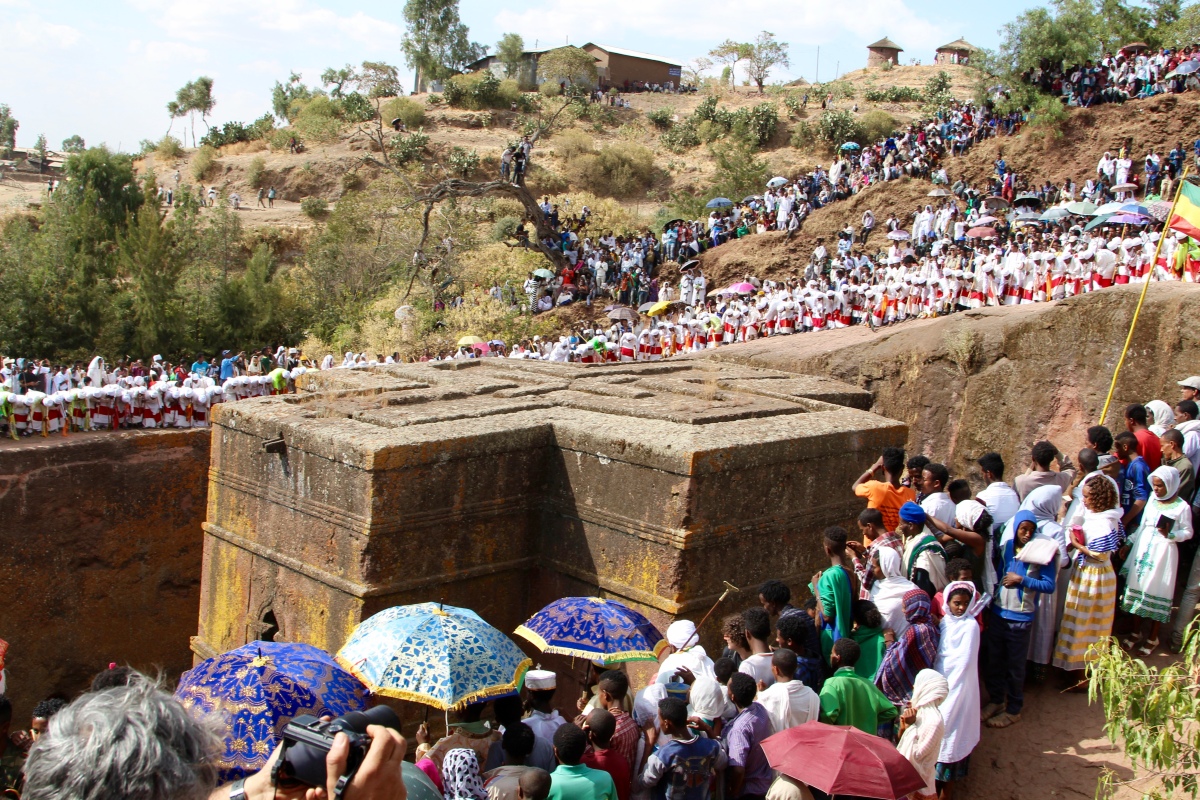
It was Bete Giorgis – the iconic church of Lalibela – in all its enormous, stony and storied glory resting below the earth’s surface.
The cross-shaped church, which dates to the 12th or 13th century, is carved from volcanic rock in a trench between 25-30 meters deep. King Lalibela built the church as part of his broader efforts to “recreate Jerusalem,” and today it is the most famous of the 11 rock-hewn churches of Lalibela. Saint George, the dragon slayer, is a major saint in Ethiopia and I was, again, very luck to land in Lalibela on the one day a year when the entire town gathers around this historical and architectural gem.
Abush and I found a spot to situate ourselves while we waited for the crowd. It started as a trickle — an occasional hoard of young men dancing, more tourists finding a seat, teenagers climbing onto trees for a good view, or few children sitting precariously close to the edge. Eventually, the entire town and every tourist for miles was sardined under the hot sun. A voice came over a load speaker, and various prayers, prostrations and other customs went forward. Abush assured me — 2 hours later when the ceremony finished — that it was very rare and very lucky to witness this event. This I already knew.
Fifi buys another dress
I didn’t have it in me to do a full church-viewing day after Saint George’s. But I rallied for a morning visit to a vast church complex that revealed not only the diversity of Lalibela’s churches, but also their architectural influence in the world, deep ties to historical events, and even to the geography of Israel (a trench symbolizing the River Jordan, for example).


From there, Abush and I walked through the sprawling Saturday market. It was a scene.


Of course Fifi bought a dress there, this one lighter and more traditional to Lalibela. The process of getting the dress was pretty hilarious. I selected 3 to choose from, but needed a place to try them on. Abush dragged me to a residential area, which I assumed included his home. But no, he said, we were just finding a family with a room to spare. Dear god, help me.
Eventually we pulled into a home where an old grandmother was smiling sweetly and encouraging me to try on the dresses next to her, where she’d shelter me from others. I put on the first dress, which was a bit big. I walked out of the light-less room and suddenly there were several women and children looking back at me. Abush was not pleased with this dress. “It’s just like ones you can get in America.”
I went back and tried on a purple dress that was more traditional in nature. The grandmother nodded and said, “konjo!” and I walked out and there were even more family members gathered. They asked if I was a celebrity, which was a hilarious thought given the amounts of sweat pouring out of me and dust all over my face.
Abush said I should try the next one. It was teal, with a ridiculous bright green lining. I didn’t like it much. But the grandmother was beside herself, nodding forcefully. I walked out and everyone said yes, this is the dress and I must get it. When in Rome…
They bid me farewell and we walked back to the vendor. He gave me an amazing price of 250 birr. I was quite pleased with my negotiation skills.
The woman who speaks Amharic
In the afternoon I donned my new, breezier dress and had a quiet lunch at Ben Abeba, the most famous Lalibela restaurant due to its canyon view and distinct, Dali-esque architecture. Abush agreed to meet me in a few hours, so I took my time. As I began the short walk back to the hotel, I was swarmed by four girls asking me all sorts of questions. They were delighted I knew some Amharic and immediately invited me for bunna. How lucky: their house was just a few meters away.
Inside, the father, a tailor, was hard at work making a traditional white dress of the north. He didn’t speak a lick of English, and we all had a blast trying to communicate with each other while the mother roasted coffee and the grandmother approvingly looked me over.
I got a call from Abush who was wondering where the heck I was. Time had slipped away. I had one of the girls direct him to us and he was amused to see me sitting there. I had just a bit of coffee, let Abush finish the rest and then we went off for a quick final church visit. But I was beat and probably only spent 45 minutes walking around. As Abush and I hopped in a bajaj to get back to the hotel, a little boy excitedly tried to chase us down and was saying something loudly.
It was a curious moment. “What was he saying?” I asked Abush.
“Oh, he said ‘Look! Look! Here comes the woman who speaks Amharic!‘”
I was floored.
“What?! How could he possibly know who I am?”
Word gets around, he told me. I was in a traditional dress, wearing a scarf, and had been invited into someone’s home for bunna. No other tourist had likely done that today.
Inken was right, yet again. Make the smallest of efforts to connect, and the world — or at least Ethiopia — will open its arms to embrace you.
That Dress Looks Nice On You
Your musical pick today is Sufjan Stevens’ That Dress Looks Nice On You from his Seven Swans album. I meant to include this in the last post, but it feels relevant for this one too.
In addition, I include Paul Simon’s Under African Skies, performed live in 1987 to much controversy during Apartheid. Much of my time in Ethiopia underscored the true faces and places of the Bible. It made clear to me that the roots of our humanity are African. That no understanding of our world is complete without a reverence and respect for black-ness.
Joseph’s face was as black as the night
And the pale yellow moon shone in his eyes
His path was marked
By the stars in the Southern Hemisphere
And he walked the length of his days
Under African skies
And, of course, that Ethiopia is no shithole country.
 Discover Your Yoga
Thank you, Alicia! What a travel story! Thrilling.
LikeLike