The Ethiopian Moses
Our last full day’s hike began with a large, mostly dry riverbed where we jumped across giant boulders for what seemed like forever. From there, a notable ascent began as we made our way to Mulit. The Simiens began to feel like Monument Valley, and with the sun beating down and several steep switchbacks before us, we had to pace ourselves accordingly.
Melaku’s knee had been bothering him since the other day, and it was giving him a lot of grief at the outset. As I watched him wince and stumble across several rocks, I finally said, “Melaku, we need to get you a walking stick.” Member found a branch that seemed promising, but it was a struggle to get it free. Of course, a local popped out from nowhere with an axe and helped take the stubborn thing down.
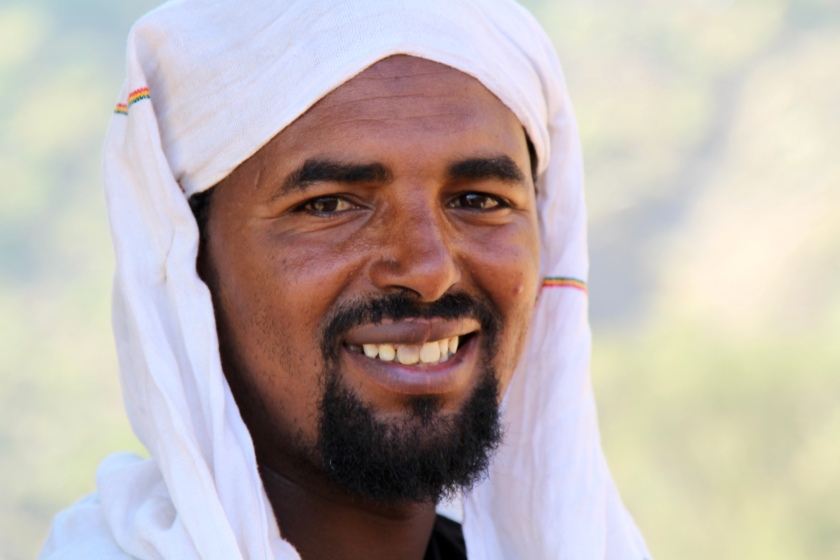
And that was it. Between the walking stick and the white shawl he was wearing over his head for sun protection, there was simply nothing more Moses than Melaku Berihun in that moment. I suspect the real Moses looked more like Melaku than Charlton Heston anyways.
As for me, God knows what look I must have had on my face because several locals, whom I swear were in their 60s and 70s, would look at me and say “be brave” or “have courage” as they sauntered by. The long and short of it is: this hike was kicking out tushies, a new word for the Germans and Ethiopians alike that I was happy to introduce to the lexicon.
Mulit
Ah, but Mulit had its own rewards.


Lunch was at a small village center less than an hour walk to our camp. We were pretty exhausted by that point and increasingly goofy. Member had a great meal prepared for us and also purchased some birtukan (oranges), while I broke open my last chocolate bar to share with Inken and Manuela. We joked about a fairly prominent rock formation in the distance that looked particularly….anatomical. I believe the Ahmaric word is biliti, so you can just look it up for yourselves.
Not surprisingly, the place was teeming with schoolchildren, and as we began our short walk to camp, at least a dozen joined us. They asked us questions and we learned that one intended to become a teacher, another an engineer, another a doctor and so own. There was a deep intelligence in their eyes. I hope that life lets them exercise their talents fully, because they all have that youthful hunger yet to be extinguished.


Inken and I had talked about doing yoga. She had a yoga mat so we figured we would take turns once at camp. But of course, we weren’t alone for long. I was relaxing in my tent while quite the crowd of children formed to watch Inken practice and teach a session to the woman who was hosting us. As the sounds got louder and louder, I decided to offer an easy flow for all of the kiddos too, so that Inken could focus. It was a simple practice – mostly standing tadasana and urdhva tadasana, tree pose and the like. But those little faces smiling and looking at you, mimicking your every move in awe…it reminded me of our TIMBo trips to Haiti. Don’t be surprised if Inken and I start a yoga venture for rural Ethiopians.
Fifi is born
Before dinner, Member and Melaku were enjoying some injera prepared by our host. Me, being an idiot, asked something about whether we were having fi fi for dinner, which for some reason I thought was the way to pronounce firfir, a traditional Ethiopian dish of spiced injera that is a popular breakfast food. Melaku was beside himself.
“Fifi,” he laughed, nearly spitting out his food. “I’m calling you Fifi from now on.”
And so it was. Over dinner, I shared my excitement about joining them to Bahir Dar after we finished the hike the next morning, because I wanted to be girly and buy a dress. Apparently I did some kind of shoulder shimmy when I said it and Fifi wants to buy a dress haunted me for the rest of the trip.
I’m not complaining.
Adirkay to Bahir Dar
The next morning, our remaining hike to Adirkay, a sizeable town, was easy and enjoyable. As I walked the final meters to meet Melis with the car, I was again swarmed by children and teenagers coming out of houses and shops to simply shake my hand and say welcome. What are you Ethiopia? How is your heart so open and big?
It was a relief to be back in the minibus and let something other than my legs carry me for a while. Our trip started down a beautiful new mountain road “built by Ethiopians, not the Chinese,” Melaku emphasized. After lunch in Debark and a pit stop in Gondar, the rugged mountains of the North gave way to more agricultural slopes, roads lined with acacia trees and eventually, the bustling city lights of Bahir Dar.
Inken, Manuela and I spent the next day shopping for a dress, which turns out to be a bit of an ordeal and a real lesson in shedding your vanity and modesty. But I was successful, and Fifi got her dress. We also shared a final meal overlooking beautiful Lake Tana with Melis and Melaku and then greeted their sister Selam, who lives in the city, for bunna and popcorn.
From Bahir Dar, I would be saying goodbye to this crew to return to Gondar for a flight to Lalibela the next day. The drive back to Gondar was bittersweet. I already missed Inken, Manuela and Melaku fiercely, but as Melis drove the van back up the winding path to the mountains, my heart swelled with the familiar sights of the North.


Head over heels, I was in love.
 Discover Your Yoga
Your writings of Ethiopia are lovely and enriching, leaving me with dreams about an East Africa where I have never been, renewed memories of a West African where I briefly lived, and song from Paul Simon “under African skies”. “Make the smallest of efforts to connect, and the world, or at least Ethiopia, will open its arms to embrace you.” That wisdom from Fifi is a simple common truth and it somehow makes me feel like a little kid again, feeling safe, lying down under warm sunlight eager to take a nap.
LikeLike