*Apologies to the faithful readers of this blog! I’ve had a hard time committing to writing since returning to the states, but I want to finish chronicling my time abroad before my memory fails me.
After Zanzibar, my travels took on a decidedly eastern flavor. As in: keffir lime, lemongrass, galanga, coconut milk and so on. Following a long connection through Dubai and a brief recharge in Bangkok, I flew to Siem Reap to spend five days exploring the crowning jewel of Cambodia: Angkor Wat. But, I found the lovely little city that serves as its gateway just as enchanting.
Siem Reap
If you want to explore the various temple compounds of Angkor, you stay in Siem Reap. I had arranged for a pick up at the Siem Reap airport from my guesthouse, and, straddled with luggage, was a bit skeptical of what I’m calling the “moto-chariot” that pulled up in front of me. As it turned out, moto-chariot performed beautifully. With a warm breeze winding through my hair, I took in Siem Reap’s scenery and breathed in the calm of solitude.

My abode, Seven Candles Guesthouse, offered immediate insight into the soul of the Cambodian people, most of whom still bear the psychological and physical scars of the Khmer Rouge and its atrocities, as well as civil war. The owner Ponheary Ly and her family are natives of Siem Reap who survived the killing fields of the Khmer Rouge. Today, Ponheary is a “CNN Hero” and World of Children Award Winner whose belief that education is the key to overcoming the cycle of poverty fed by Cambodia’s violent past drove her to found the The Ponheary Ly Foundation. The guesthouse helps support the foundation, and brought a real familial and homey touch to my stay in Siem Reap.
In general, I found Siem Reap to be a relaxed and pleasant town, although it’s one that is being forced to grow quickly from the pressures of tourism. Here are a few of my favorite things about Siem Reap:
- The unapologetic and ubiquitous use of hammocks. At every tourist attraction, various restaurants, and generally just everywhere, there are hammocks. Where you see them in large numbers, they are likely for the many tuk-tuk drivers who wait it out while their customers enjoy a given attraction, but people of all kinds were using them. Good on ya, Siem Reap

- Monks. Brilliant turmeric-colored draping covers the monks who live, pray, drink coffee, talk on cell phones, and ride in vehicles throughout Siem Reap and the temples nearby. Much like the Maasai men and women who dot the hills and towns of Tanzania, I couldn’t help but feel a little thrill in my stomach when I would see these monks going about their day-to-day lives. It was another flavor that gave my time here its deep sense of place and wonder.


- Ammo, a little jewelry shop situated very close to my guesthouse, which was birthed out of a common Cambodian practice of re-purposing bullets into a base metal for jewelry. The bullets that Ammo uses today are luckily not drawn from bloodshed, but stand as a symbol for Cambodia’s troubled past. Local jewelry-makers learn their craft and get to create their own designs as part of this social enterprise.
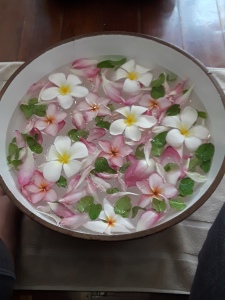
- Kandal Village is the hip, creative and growing corner of Siem Reap that features restaurants, cafes, artisan stores and galleries. While I enjoyed all my time dining and perusing its shops, the highlight for me was an afternoon at Frangipani Spa. While you can get dirt-cheap massages in both Cambodia and Thailand, I enjoyed the splurge on my “Four Hands Massage,” which was an hour massage with TWO massage therapists, all for $60. Divine.
- Artisans Angkor began in the 1990s as an educational project sponsored by the Cambodian government, mostly as an art & cultural vocational school for rural Cambodians. Within a decade, the program drew additional support from the European Union and is now a full-fledged workplace training program for craftsmen engaged in Khmer cultural arts like ornamental sculpture, gilding, silk painting, silk-making, lacquering, and wood and stone carving. Different workshop rooms are guided by instructors, with notable orders from around the world for their goods being tracked and fulfilled on big whiteboards. These artisans take pride in their impeccable work, which is displayed not only in the compound’s impressive show room and store, but in various airports in the country and shops around the world.


Temple Mania
Of course, I spent a few days exploring the many temples that hold the history of the once-mighty Khmer empire. Tourists generally spend 2-3 days exploring the various temples. It’s hard to appreciate how vast these areas are until you’re there, but the map below gives some sense of the scope in comparison to Siem Reap itself.

Greeted by my guide, Yim, we began our moto-chariot journey through these many complexes. As it turns out, Yim was a part of the film crew for Angelina Jolie’s film First They Came for My Father, as both a translator and later camera crew. We talked a bit about her devotion to the Cambodian people.
“Angie’s great,” Yim beamed, as he reflected on his time on set of the film dedicated to survivors of the Khmer Rouge.
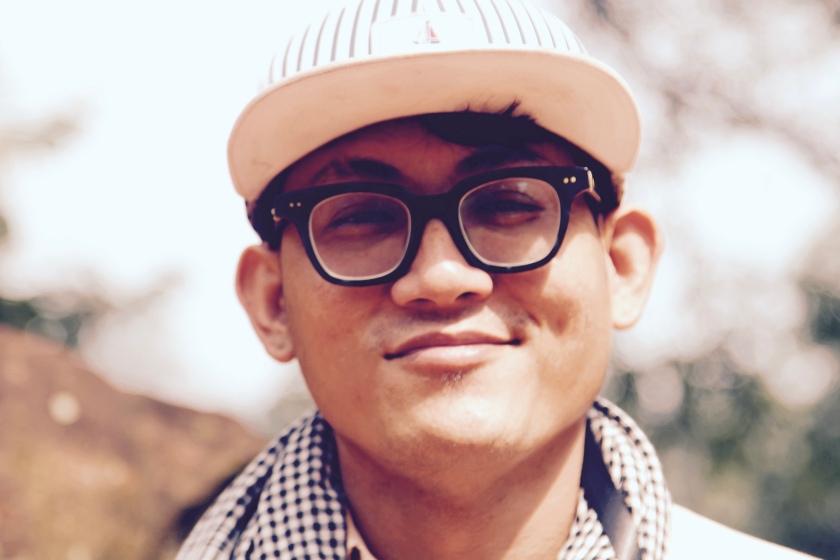
Our conversation meandered to cover the impact of tourism on the infrastructure and cultural fabric of Siem Reap, Cambodia’s still-wrought political landscape, and some of Yim’s aspirations for he and his family. As we pulled into the official grounds of the Angkor sites, a deeply forested landscape helped cool down the oppressive heat and humidity just enough to prevent me from completely sweating through all of my clothes. But I got pretty darn close.
Below are some of the highlights of the temple tour, but there really is no better way to appreciate this World Heritage Site than to visit it yourselves. Please add it to your bucket list.
Banteay Sray
Banteay Sray is noteworthy as one of the oldest temples in the Angkor region (dating to the 10th century) and is popular because of its intricate carvings that have withstood the test of time. A temple originally dedicated to the Hindu god, Shiva, it lies about 30 kilometers north of Siem Reap, but is worth the moto-chariot ride.


Ta Prohm
Ta Prohm became globally recognized from the Tomb Raider movies, but its mesmerizing stone-and-tree-roots tapestries make it a worthy stop on the temple route regardless of its fame. Built by Buddhist King Jayavarman VII, or “Jay 7” as Yim would tell me, Ta Prohm was originally a Buddhist temple and university.
Today, it’s super fun to climb around. One of the security guards gave me a “secret” tour to see the guardian gods/goddesses of the temple, tucked away in various corners of the temple that have since crumbled from the force of tree roots. Hence, there was a good bit of scrambling up and down rock ruins at this stop. Not advised or even accepted for most tourists, it was an unexpected perk of being a solo traveler.


Bayon: “The one with the faces!”
As Yim would point out to me, one of the ways you can distinguish Buddhist temples from Hindu temples in the Angkor region is by whether or not they are elevated. Tall temples with many steps and great height are generally Hindu, and those that are more flat are generally Buddhist. Bayon is another creation of Jay 7, a Buddhist king, and there is some debate about who the many faces of Bayon and the walled gates of Angkor Thom, the palace compound that Bayon sits within, represent. Are they Buddhas? Are they representations of the king himself? We don’t know.
There are actually both Buddhist and Hindu aspects to Bayon, since it underwent revisions under Hindu rule. As in other temples, you could see this by the erasure of buddha faces or removal of buddha heads on various statues.


Angkor Wat
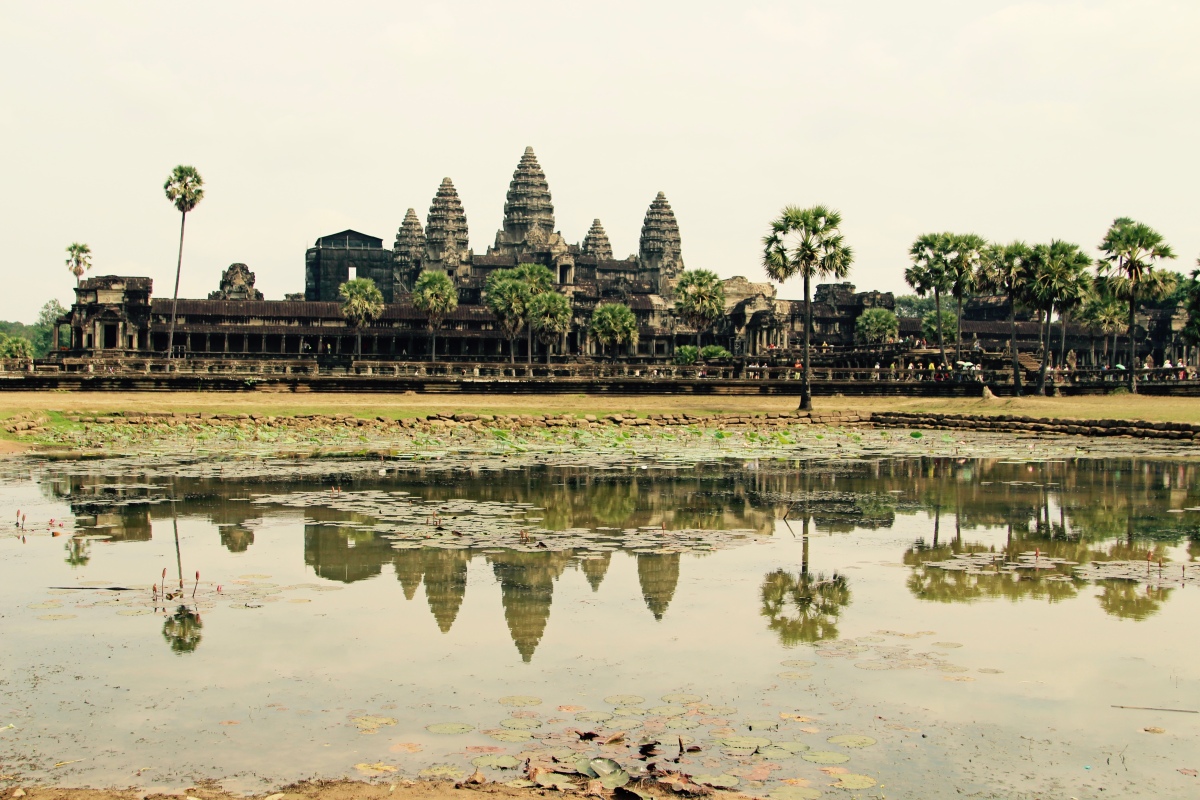
Ah, Angkor Wat. The world’s largest religious monument that stretches over 400 acres. My time here probably wouldn’t have been enjoyable had Yim not figured out how to beat the droves of Chinese tourists who would flood the compound as we were leaving. There was literally no wait for me to reach all corners of this temple, including the very steep ascent to the temple-mountain at the center of the complex, where it is not unusual to have to wait an hour or so to climb. Good thing, because there’s a lot to see.
Built by Suryavarman II in the 12th century, Angkor Wat was originally a Hindu temple devoted to Vishnu, but became a Buddhist temple later that century. It is encased by a giant moat and an outer wall with distinct entrances for commoners, special guests and dignitaries and royalty. The entire complex includes a library, galleries upon galleries, a large reflecting pond with lotus flowers and lily pads, and vasts reliefs and scripts that tell the story of its structures.


Yim made sure I saved Angkor Wat for last, and after our substantial time there, I refueled with some coconut water, fresh from a giant coconut, and returned into the heart of Siem Reap to ride out another peaceful day in this special place before I would move on to Chiang Mai, Thailand.
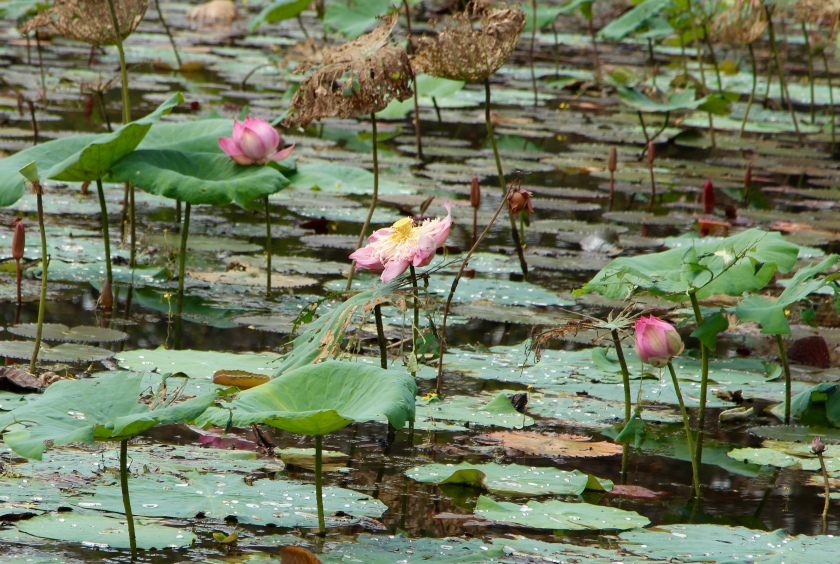
I spent a little time reflecting on the lotus flower, which I had never seen before in person. Yogis talk about the beauty of the lotus flower arising out of the muddy waters and it seems an apt symbol for the resilient spirit of Cambodia. I hope to return there, since I only skimmed the surface of a country filled with beautiful people who have endured the very worst of humanity and who continue to heal and rebuild.
 Discover Your Yoga