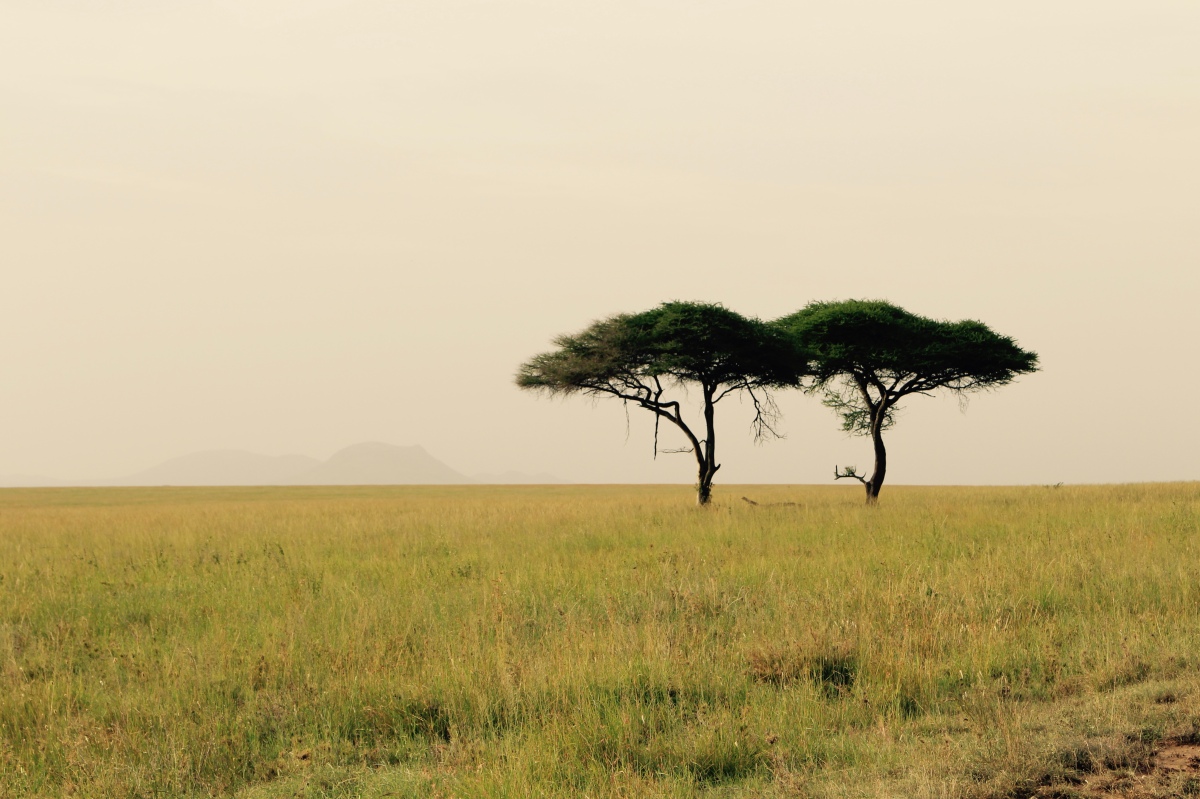
I’m not even sure I need prose for this post. I could simply flood you with a gazillion images and you’d get the idea. However, my site can only take so much data, and there is actually a bit of story to tell.
Ngorongoro Crater
It’s hard to do justice to the Ngorongoro Crater in a single image. Forming from volcanic activity that began over 20 million years ago, the crater spans 100 square miles and earns a spot as one of the distinct geological features found along the Great Rift Valley. Tanzania has a great history of conservation, a credit to its own leadership and the influence of German conservationists who supported the establishment of the greater Ngorongoro Conservation Area — a vast 3,000 square miles. Let’s be grateful for those forward-thinking individuals.
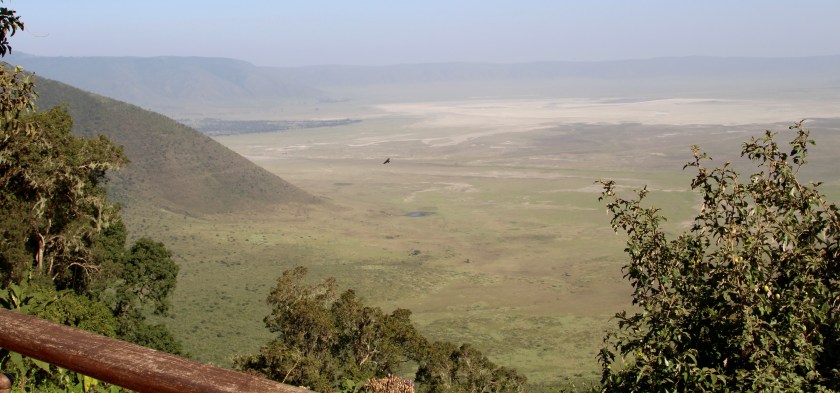
To explore the crater and do our game drives, we abandoned the Intrepid beast for 4×4 safari land cruisers. Departing Mto wa Mbu, we started a notable incline to the ridge of the crater, passing Maasai villages on the way. As we approached the main visitor center, baboons cluttered the side of the road in animated (and, um, amorous) fashion. It doesn’t take much to see something deeply human beneath their monkey business. Imagine, if you will, a male mounting a female, only to have her yell and swat him off of her in frustration, as if to say “Not in front of the kids!”
From the height of the ridge, binoculars offered a better sense of the activity going on in the crater. To be honest, I thought we were in for a boring day. There were a few clusters of activity, but it looked like herds of zebra and wildebeest mostly.

Thank god I was wrong.
There were a few security checkpoints between the main entrance, the top of the crater and then down to the floor. It’s one of the ways that the Tanzanian government has been able to eradicate poachers from the country, although that came at a cost. A giant plaque commemorates the many lives lost to poachers, animals and accidents that happened in the name of conservation.


From a final checkpoint at the ridge, our driver, Immanuel, nicknamed Mr. Serengeti, changed out our roof for better viewing. From there, we took a steep, bumpy trail down.
Not five minutes later there was a female lion walking among a large herd of zebra and wildebeest. She was just a handful of meters away from her next meal, while her lady friends lurked in the bushes nearby. We didn’t get to see them make a kill, but it was clear that every prey animal was aware of their presence. These animals do a fairly transparent dance with each other in their game for survival.


I do not exaggerate when I say the animal viewing was nonstop from there. The sheer density of animals in one space, and the amazing biodiversity found in a few square meters was jaw-dropping. We saw several dozen lions, several thousand zebras and wildabeest, hippos, hyena, Thomson and Grant gazelle, the diminutive dik dik, elephants in the distance, ibis and another gazillion birds of interest, and even a few ever-shy black rhinos. You would occasionally see a bunch of land cruisers parked in a row, which was always a clue that something of interest lay ahead. Usually it was simba (lions), which took our breath away every time. There is just something about lions. They own it.
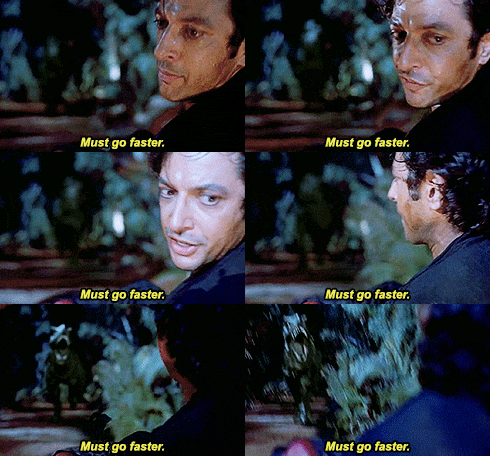
Must go faster
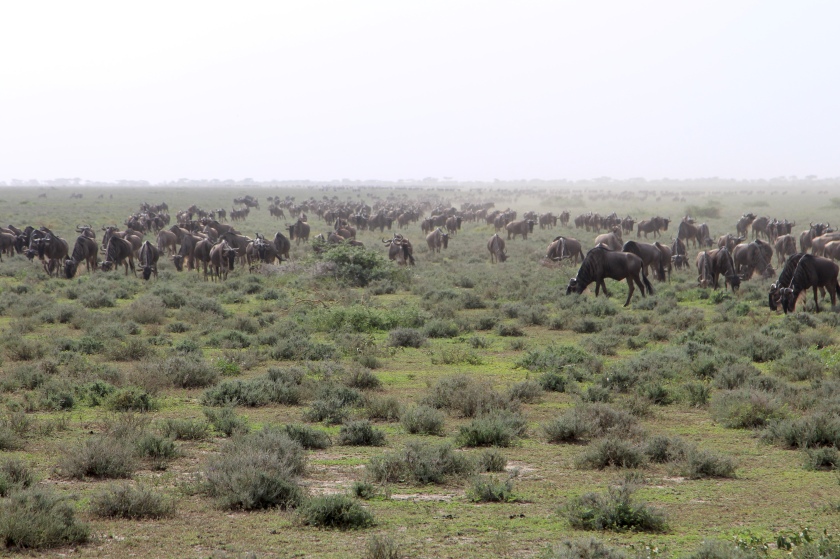
As we left the crater, the sloping hills that housed a number of twiga (giraffe) yielded to a flattened landscape that extended into a vastness I’ve yet to see in the U.S. We were not yet in Serengeti National Park, but we were clearly close. The wildlife viewing did not stop there, since a massive migration of zebra, wildebeest and gazelles was underway.


I was sitting shotgun now and in Immanuel I found a fellow lead-foot. He loved his land cruiser and worked it like a pro. He also firmly believed that going faster made the ride smoother. Who am I to disagree?
As we neared the Serengeti, again there was a row of land cruisers lined up. A male lion sat mere inches from our vehicle. He was a bit older than the others we’d seen that day, given the black in his mane. As he writhed around on his back playfully, the distance between lions and domestic cats felt eerily close. But someone in a neighboring vehicle waved and made a noise to get his attention and with laser-like speed he flipped over and sustained the most intense stare their way. He didn’t let them out of his sight for what felt like an eternity.
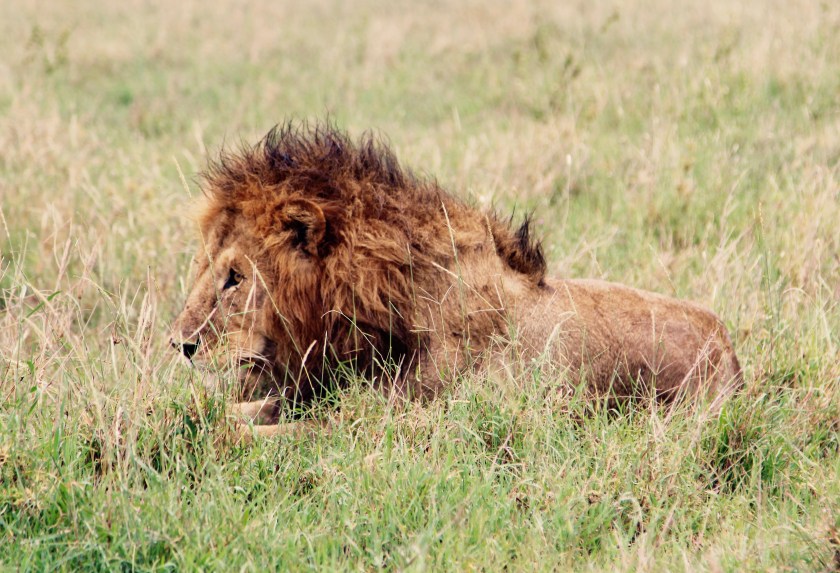
Very quietly, Immanuel inched to me and whispered, “would you please roll up your window a little bit?” I obliged. In a few moments, the lion decided the humans were no threat and went back to grooming himself. We moved on from there at quite a clip.
We made it just a few hundred meters beyond when I smelled something burning, although no one else seemed to agree with me. But my sense of smell is pretty accurate and seconds later, smoke was fuming from near Immanuel’s leg. He stopped the car and pulled us over. Lifting the hood, he couldn’t seem to locate the cause. Though it was comforting to know that Mr. Serengeti was also the mechanic for the tour company, it was unnerving to remember that a male lion was a quick sprint away. I couldn’t get this image out of my head:
Eventually, he identified the culprit — a fuse for the blinkers was literally melting into the car. So, like any good mechanic, he removed the fuse. Who needs a turn signal in the Serengeti anyways?
The Land of Endless Space
With a few hours of daylight left, we arrived at the gate for Serengeti National Park, although we were about 20 minutes ahead of the others in our group, even with our delay. This would keep happening throughout our two days in the park. Immanuel is a speed demon.
Just before the others pulled up, two Maasai kids walked our way, asking for money and candy. I chatted them up for a few seconds when suddenly their eyes grew wide. They crouched down and crawled behind the truck and I followed them, wondering what game they were playing. In a flash they sprinted. As Immanuel informed me, the Maasai are not allowed in Serengeti National Park, and a park ranger had spotted them. The ensuing chase was hilarious.


The word Serengeti is derived from a Maasai word seringit, which literally means the ‘land of endless space.” As we made our way into the park, that space made itself known, although we’d come to appreciate it more later.
We set up camp that evening in the rain, at a unfenced campground in who-knows-what corner of the park. Victor informed us that you wanted to brush your teeth and do your business as soon as possible. If you woke up in the middle of the night, you could only move a few feet from your tent to minimize the chance of an animal encounter.
In fact, the next morning as I walked to the bathroom to brush my teeth, trash was strewn all about the pathway. “What asshole made this mess?” I thought to myself. Hyenas is the answer. I slept through their sounds that night, but the following night I would notice the glow of hyena eyes staring back at me when I flashed my headlamp toward my tent. By the time I was set up to sleep, Holly informed me that a few hyenas were about two feet away from our tent. I could hear their cries, of course, and in my head I knew there was little of interest to them in my tent. But still…
Poa kichizi kama n’dizi
Our mission the next day was to spot a leopard, or chui in Swahili. That takes some patience, as they are shier than the other cats and like to hide in trees. In fact, bigger game was few and far between that day. But, trading in the crater’s density for the vastness of the Serengeti forces an appreciation for less flashy aspects of this special ecosystem. The termite colonies that dot the landscape, for example, are also favorite spots for bees to make honey, and are enjoyed by families of mongoose as well. And there are so many brilliant birds with brilliant songs meandering the trees.
And of course, there is the utter silence and space of the savanna.


In the quieter moments, the five of us — myself, Holly, Immanuel and Chelsea & Carol, an Australian mother-daughter team — had our own fun. Immanuel loved to make the sounds of all the different animals, which had us rolling in laughter, especially when we tried to imitate him. And while Chelsea & Carol were enjoying a hot air balloon ride over the park one morning, Immanuel taught Holly and I the most useful Swahili phrase ever. Basically, a typical exchange between a Tanzanian and a tourist is as follows:
Jambo! (hello!)
Jambo! (hello!)
Mambo? (How are you?)
Mambo poa. (I’m good / cool)
Simple enough. Swahili is a pretty easy language in that words sound exactly like they are spelled out. For myself, it was easy to seal a new word into my brain once I’d heard it. The script above was a piece of cake. However, if you want to lift some eyebrows, you say poa kichizi kama n’dizi (n’dan ya frij) — I’m cool like a banana (in the fridge). Faces will light up, which is saying something because Tanzanians are pretty sunny people.
We also had a bit of fun between the different land cruisers. As I worked to pick up some Swahili, I learned that the word for rhino is faru. Victor, I told Immanuel, is a faru. He’s just got their presence. Immanuel thought this was hilarious and raced up beside Victor’s vehicle and had me say in Swahili:
“Victor, you are black like a rhino.”
Let it be known that this wasn’t what I meant at all. Victor looked at me perplexed. Then he laughed, scratched his head and countered something back in Swahili. Immanuel was in stitches. I asked him what he said and he quipped:
“He said, ‘You are white…like an egg.'”
We could not stop laughing for the rest of the ride. Although, none of us are convinced that’s actually what Victor said.
So long, Serengeti.
Of course, there were proper excitements in the Serengeti. We managed to spot a leopard and baby that morning, and once we picked up Chelsea and Carol, Immanuel raced back to the tree so that they could enjoy too. That afternoon, while searching for a cheetah in the “pride rock” section of the park, we found a pregnant lioness who walked right in front of our vehicles. We could not get enough of her.


And of course, we ended our time in the Serengeti with some shenanigans, like a land cruiser dance party. There was something so liberating about standing, wind whipping my hair about with the endless meeting of earth and sky in all directions.


As we tracked down their migration, I came to appreciate the wildebeest too, whom I had deemed so boring before. Lined up against the horizon, they stretch on forever. Sure, they are dumb as nails. But they drive the entire ecosystem — moving between Kenya’s Maasai Mara and Tanzania’s Serengeti in search of water or safe breeding ground, depending on the time of year. Zebras and gazelle follow suit, and benefit from each other’s vigilance against predators, but none travel as far as the wildebeest. Migratory predators (hyenas) and territorial ones (lions, leopard, cheetah) bank on their vast numbers for the majority of their meals each year. Their excrement, in turn, keeps this soil fertile, and, I assume, is delicious for all the insects and vermin of the savanna as well. That’s the circle of life, my friends.
Music
As if there could be any other song for this post. It still gives me goosebumps, all these decades after its initial release. I can verify that this video is 100% accurate. I saw lions and baboons embracing all the time.
Tanzanians were pretty into this song, too.
Remember: home is where your rump rests, fair readers.
 Discover Your Yoga