I write this from Bangkok, having left Zanzibar yesterday for a long flight and layover in Dubai. My heart feels a bit heavy today. It could just be the jetlag but more likely, it’s the simple weight of leaving Africa and knowing I left a piece of me there. I have every intention of coming back one day, but the distance felt very real, regardless, as I ate my massaman curry this afternoon.
In cultural anthropology, there is a term called liminality. I think of a liminal space as one of transition — of in-between, topsy-turvy, or being-on-the-brink. Celebrations like Mardi Gras or rites of passage are good examples of customs that provide an essential symbolic space for an individual or cohort’s transformation (male circumcision ceremonies in Africa, certain wedding customs) or where traditional norms are suspended in order to allow for creative expressions and releases that are not allowable in day-to-day life. In all cases, there is a sort of limbo — you are neither this nor that. No longer who you were and not yet what you will become.
A good traveler encounters liminality all the time, stepping out of comfort zones to try new ideas, paces, languages, clothes, foods, and customs. By leaving our normal context, we discover what is indelible and what is malleable. We shed the nonessential and integrate new things.
My transition between Ethiopia and my Kenya-Tanzania trip offered this kind of limbo.
Amesegnalehu, Ethiopia.
Ethiopia ripped my heart open. I wasn’t expecting to fall in love with its people or its landscape. Yet somehow I shifted from being downright terrified to step foot there to feeling at home, with my feet firmly planted on the ground and even considering growing roots.
I spent those last few days in Addis. From Lalibela, Amin picked me up from the airport looking 10 lbs lighter than when I’d left him and a bit too weak to help with luggage, although he tried. I think Sarah is still trying to fatten him up after whatever virus knocked him down, but he recovered just fine over the following days.
I missed the north terribly, but it was rewarding to spend quality time with the family. As a general rule, I’m pretty good with kids. But the last time I’d seen Salim in Boston he was a toddler, and Leila was an infant. Yet these two kiddos embraced me like family from the moment I stepped foot in their house. Now back in Addis, I fit seamlessly into their routine. I picked them up from school one day, where Leila walked around holding my hand. They would both curl up into me as I read them Curious George stories and they would eagerly show off toys or ask me to color with them whenever there was a free moment. I’m told that Leila only wanted to use “Alicia’s bathroom” once I’d left.


I had a few adventures in the city. The first was a great massage at the Boston Day Spa, owned by someone who used to live in Boston. It has this beautiful, vast and dimly lit underground space that felt like it could have been in New York City or something. Sarah and I attended a yoga session taught by a Kiwi expat, and also did a home practice one evening. It was interesting to remember what my body felt like not doing a regular yoga practice, particularly in an arid environment like Addis.
I also visited the Ethnographical Museum, whose main exhibit is organized around life stages (from birth to death) as an opportunity to highlight dozens of different ethnic groups and tribes that populate the country (at least 80 different groups call Ethiopia home). That same day, I stopped by the National Museum where Lucy, everyone’s favorite Australopithecus afarensis, lives. Meandering the displays of Australopithecus africanus, Ardipithecus ramidus, and Homo habilis, I felt like I’d stepped off the textbook pages in Stephen Bailey’s Physical Anthropology class at Tufts University. All my nerdy dreams come true!

Speaking of Lucy: when I was in Lalibela walking around in traditional garb, a friend of Abush’s smiled at me and said,”Do you have some Ethiopian blood in you? You look like Lucy!” That joke could play anywhere.
Seriously though, it’s no surprise that so many Ethiopian stores and restaurants have Lucy in their name. Being home to the cradle of humanity is not bad for the brag sheet. Archaeologists and anthropologists are still discovering the remains of humans and our many ancestors throughout Ethiopia’s regions. Slowly, the puzzle pieces of our shared past are being uncovered in a broad tapestry that keeps getting larger and larger. We may never know what we don’t know, but it was fascinating to see which gaps had been filled in, expanded, and reconsidered in the decade since I’d left the classroom. Talk about liminality…
I also got to spend some quality time with Inken, Manuela and Melaku after they returned from a trip in the south of the country. We even pulled out the German tarot card deck one last time to see what the universe had in store for us, while I listened to details about their trip visiting Konso, where the main attraction is really the people and their fascinating culture. At least to we Westerners.
On my last full day in the city, Sarah and Amin hosted a brunch for a pretty great slice of Addis Ababa’s expat community. It was fascinating to hear about all the many paths that led people to this special country.
The next morning, I headed to the airport wondering if I would be leaving Fifi behind forever.
Jambo, Intrepid!
There wasn’t much time for my transition to Intrepid Travel’s Road to Zanzibar, which I’d tacked onto my travels after my friends Rachel & Kieth Hoffman, who live in Zanzibar, suggested I visit them. You know: just a hop, skip and a jump.
Or more like several hundred kilometers of very bumpy roads. I landed in Nairobi on February 4th and that evening had an orientation meeting with the group that would be my travel companions for the next two weeks. I tried to be cheerful and fully present, but my mind kept drifting back to Ethiopia, even the next morning as we started our long drive from Nairobi to Tanzania.

For anyone choosing to do an Intrepid adventure in Africa, you will likely become acquainted with their enormous trucks, which are retrofitted flatbeds specifically designed for the company. They come equipped with lockers, special stalls for the mattresses and tents used at campsites, a ton of storage compartments for our food and fuel, two spare tires and giant windows that stretch to the roof.
In addition to our tour leader Victor, our chef Emmanuel and our driver Boniface, the truck became a character and member of the group in its own right. They are giant vehicles that make it nearly impossible for locals to ignore, particularly in more remote areas.


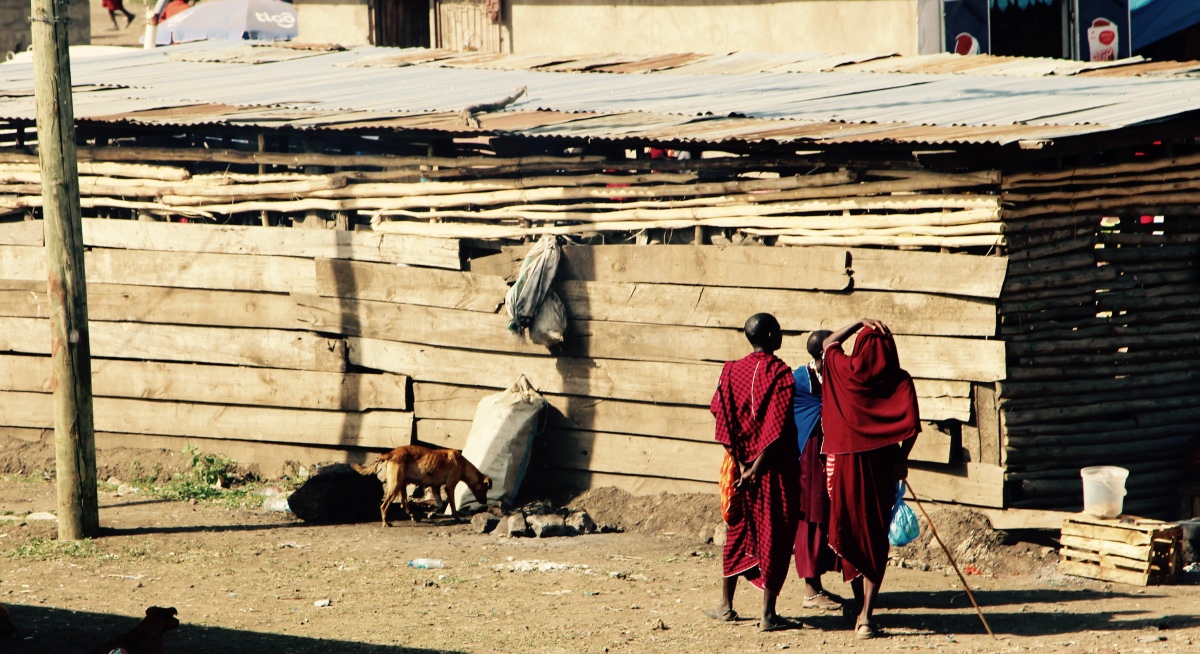
Looking out the window on the road from Nairobi into Tanzania, what I noticed first was the blood red garb of the Maasai dotting the streets and landscape, particularly as we got closer to the border. How was I here?
Though Kenya lies just south of Ethiopia, the landscape was greener than in Ethiopia and the people a bit feistier or more gregarious. The street and store signs were in English in Nairobi, and then a mixture of English and Swahili as we moved south. Underneath Victor’s Kenyan accent was a hint of something Anglo, and as he discussed some of the sites outside our windows, it was a good reminder that the British had colonized Kenya in what was called British East Africa by the time of World War I, whereas the Germans colonized much of what is now Tanzania, then called German East Africa. That influence makes itself known in obvious and subtle ways in this part of East Africa. It added a flavor that I could not feel in Ethiopia, which was never colonized but merely “occupied” by the Italians under Mussolini for a brief period (hence, the occasional piazza in a city).
When we arrived at the Twiga (Swahili for giraffe) campsite in Mto wa Mbu, which literally translates to mosquito river, we set up our tents. Since we would be heading into the Serengeti during our safari and camping in unfenced sites, our tents were a thick canvas that’s more durable and, I assume, better for protecting our belongings and bodies from any interested animals crossing our paths.
I headed out with our tour leader Victor and my Aussie tent-mate Holly to try to get a local SIM card. We hopped in a tuk-tuk and drove several meters into the heart of town. It was ultimately a failed mission (thanks a lot, T-Mobile), but I distinctly remember goosebumps coming over me as I watched a tall Maasai man chatting up a guy at the local bar out of the corner of my eye. A Maasai woman also came up to us, shook our hands, and tried to sell us some bracelets she’d made. It was really her big dangly earrings that interested me, which I can never resist when I’m traveling. I’d manage to snag a bunch of those later that week.
Emmanuel made us a delicious dinner and I quickly adjusted to the Intrepid meal routine — cleaning our hands with treated water, lining up buffet style for food, communally cleaning and “flapping” our eating-ware dry and then returning everything into their proper bins and helping to reload the truck. I hadn’t yet made strong connections with the group, which included several Australians, a trio of Swiss friends, a Canadian couple, two British couples and myself, the lone American.
In the dark, I grabbed my shower gear and as I left my tent, noticed several fruit bats ping-ponging between the trees above. It made me wonder what else was lurking in the shadows, and my pace quickened. By the time I returned to our tent, there was bat poop all over the canvas. Holly and I later discovered that ours was the only tent to receive this special treatment that evening. Fun times.
Despite missing my Ethiopian friends fiercely, it was clear that Holly and I would get along just fine. We were both the same age, well-traveled and friendly. We liked our fun, but also needed down time. Perfect.
It was a humid, sweaty evening sleeping in that tent, but I was tired after a full day’s drive. The next morning, we met our Safari guides and headed into the Ngorongoro Crater, which I’ll cover in my next post. Get ready for a wild and crazy 4×4 ride that properly kicked me out of my liminal state and into the present, fair readers!
Music
As this is my last post on Ethiopia, I share Teddy Afro’s Mar eske Twauf, from his Ethiopia album released last year, which reached the top of the Billboard World Albums Chart. The piece is a labor of love that captures a historical story — I’ll have to call on Inken or Melaku to explain it more fully. But it is wildly popular in the region. It features Afro’s wife Amleset Muchie, a famous actress in the country, and many of the traditional clothing of the north, as well as some footage of the Simiens.
I’ll also throw in Oscar Isaac and Marcus Mumford’s Fare Thee Well from the Inside Llewyn Davis soundtrack. Until we meet again, Ethiopia.
 Discover Your Yoga