Day 2: The Trek to Sona
From Buwahit we made the long trek to Sona for camp. I believe this is when I fell in love with Ethiopia.


Our trail meandered through vast landscapes, revealing just how diverse the Simiens’ terrain is, how warm and friendly its people, how wide an area that silence can hold. Even in this dry season, without its green hills, there is a deep beauty to this land.
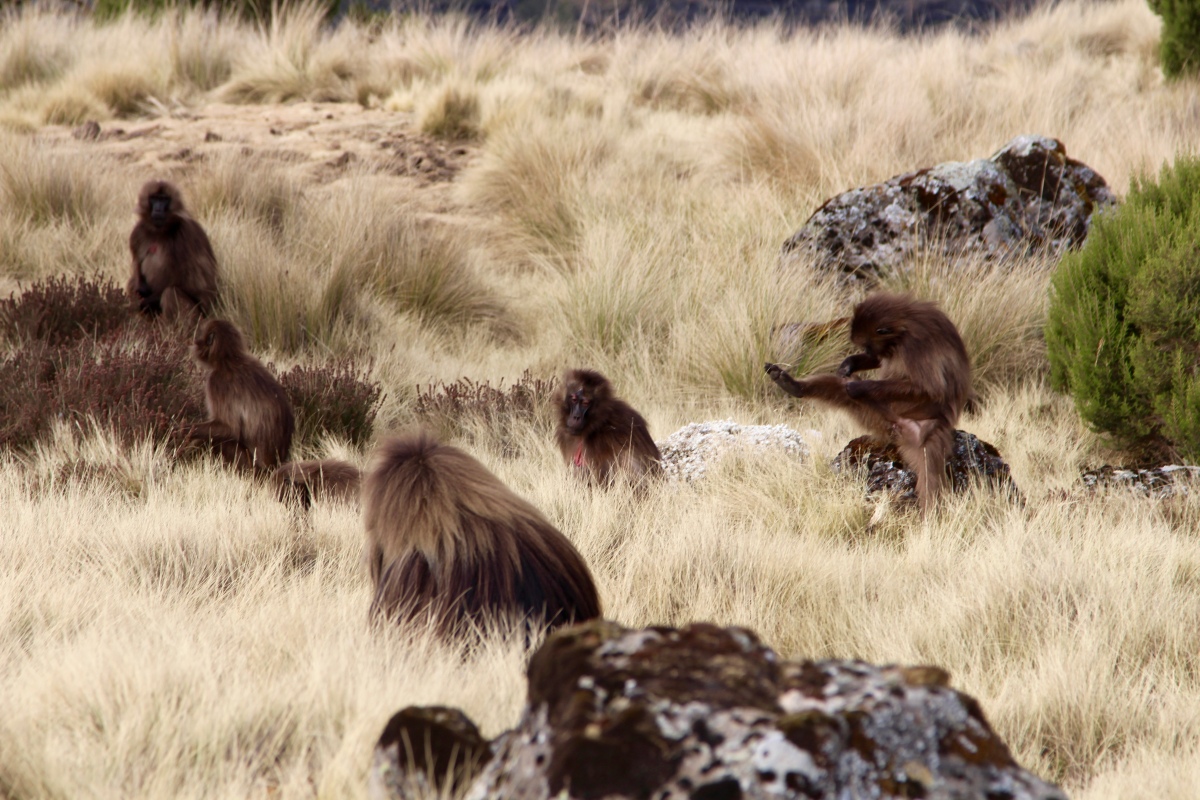
We frequently passed gelada monkeys as they moved around in their big families. It’s fun to watch them interact with each other — the babies falling over each other or chasing their mother for milk. The older males clearly positioning themselves to intimidate or protect others from these weird humans invading their space. They have a good life, those monkeys.
We walked alongside farms or, more commonly, pastoralists with herds of sheep or cattle roaming the hills. Always they would greet you. Off in the distance we’d hear tiny voices yelling “Selam nu!” and soon enough, little feet and faces would be hurrying our way, eager to shake our hands. Often, they’d look up at me with big eyes and ask “Pen? Pen?” Next time I’m bringing 1,000 pens with me.
It was overwhelmingly enchanting. Travel like this strips you of labels and vanity. I mean, who is Alicia Harvie anyway? All I could sense was one spirit connecting to another, my own feet ambling through this eternal earth that had no end to its beauty, and herds of cattle making room for an anonymous stranger. It can be unnerving to travel to a place devoid of the familiar coordinates that help you navigate your identity or purpose. But it can also be magical.
Sona Elementary School
Member, the cook, decided we would stay overnight at the school in Sona instead of the usual campsite. So we set up shop and were immediately swarmed by kids. No doubt we were the hottest news of the day.


I spoke with some of the teachers, who were for some reason impressed with my pithy Amharic. One taught chemistry, one taught English, another mathematics. They spoke of wanting to go to America and wondered what my views of President Trump were (they are quite aware of his attitudes toward black people and Africa) as well as President Obama. America’s light, as well as our shadow, can cast so far over this world.
Meanwhile, Inken had befriended some children living adjacent to the school (as in, literally next door), which inevitably led to an invitation for bunna and injera in their home. Outside of the meal I had at Melaku’s, this was the first time I was invited into someone’s house. Whereas Melaku’s home was equipped with different rooms, a giant TV and comfy couches for guests, this was a singular hut without any light source. I could hardly see in front of me, clumsily making my way to a bench stationed in front of the hearth where the mother started the bunna process over coals.
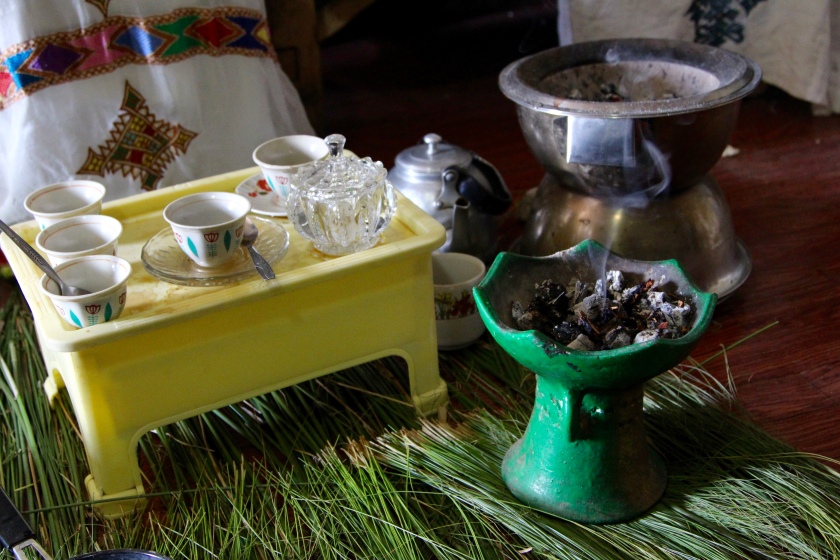
There was no ventilation for the smoke generated in that hut and as she passed around the pan of roasted coffee beans (for us to smell and nod and smile in approval), I tried not to cough. My clothes still carry a hint of smoke and bunna, even after being washed.
One of the daughters showed us her schoolbook as the mother started to clean out the little china cups traditionally used to serve bunna. Injera, the traditional spongy sourdough bread that accompanies every meal in Ethiopia, was presented. Inken and I took our right hands and sampled some, but tried not to ruin our appetite for dinner. As we readied ourselves to leave, Inken offered $200 birr for her kindness, which translates to about $7 USD.
That evening, we ate our meal and sat around a fire with our crew and staff from the school. Somehow, Sona was chillier than Chenek that evening. I curled up tight in the down jacket that Amin loaned me for the trip. I didn’t have to wait long for my legs to feel burning hot from the fire just inches away. In the dry season, it’s a wonder something didn’t catch fire.
Day 3: Bizuna Abwara
Speaking of the dry season, here’s the thing about the Simiens: they. are. dusty. I learned that the word for dust is abwara, which to my ears sounds more like avora. When you want to say “a lot” of something, you say bizu. But in truth, I was dealing with bizuna abwara, which roughly translates to a “shit-ton of dust.” I was basically an entirely different color by each day’s end:
The next day, our harrowing trek down to the river brought much more abwara as we navigated a trail that, let’s be honest, was really just a rock slide. Everybody fell at some point except Abati, the scout. Even Inken, who is nicknamed the Mountain Goat, took a slip toward the end. But fear not, dear readers, Ethiopia’s Alicia is still the Alicia you know and love. I was the reigning champion of falling, hitting the dirt at least 11 times.* The locals, it’s worth noting, ambled down the steep descent easily, often nudging donkeys in front of them, and without hiking boots to support them. Amazing.
*conservative estimate
The trail was absolutely beautiful that day. Not only were the mountains more lush and green, but we saw a huge variety of wildflowers. We even came across jasmine, which we three women took for ourselves and smelled throughout the hike to connect to our feminine power and energy. It was Inken’s idea.


At lunch, we bathed in the river while the men went and set up our station. We were of course joined by several curious children that appeared out of nowhere. Despite its remoteness, there really is no privacy in the Simiens. It made for interesting pee breaks.
A short trek from there brought us to Mekarebya, a small village that was our camp for the evening. We bought a few handcrafts from the women and again engaged with the children. Although it was the most populous place we’d seen in the Simiens to date, conditions were rough. Melaku, who worked as a nurse before beginning a tourism career, believed a child had polio (I thought it was rickets), and despite their bright dispositions, the kids were envious of our food and wanting for better clothes. As we munched on some popcorn, a common snack served with bunna and shay (tea), we couldn’t help but sneak some to the kids. But this only caused them to fight with each other and Inken had to intervene a few times.
I’m sure we all went to bed that evening wrestling with some guilt over our relative wealth, comfort and health. The problems are structural and so much bigger than any one individual. I never regret witnessing how other people in parts of the world live; in fact I think it’s essential. But, it doesn’t leave you with easy answers. I don’t presume that my way of living is ideal or that they are miserable. But no one should have to face hunger, or the threat of diseases that are easily vaccinated against, or live without adequate clothing in today’s world. We have enough to go around; we just haven’t displayed the political will to make it happen. I think of a passage from Pirkei Avot, a Jewish text that I was into as a teenager:
“You are not required to complete the work (of perfecting the world), but neither are you free to ignore it.” ~ Rabbi Tarfon 2:21
Or perhaps this one, which is pasted proudly on the Food for Free donation trucks around Boston:
“When I feed the hungry, they call me a saint. When I ask why people are hungry, they call me a Communist.” ~ Dom Hélder Câmara
“I like that you are amicable with the people,” Melaku said to me after I walked away from a small group of kids, a big smile on my face.
“Isn’t everyone like that?” I asked.
“No,” he said simply. “Not all tourists want to interact with them at all.”
Music
You get many fun gems for this post, friends. First, Dirty Laundry by Annie & the Beekeepers. Mostly for the title, although there’s some relevant lyrics. Also because it’s a Boston band.
And in honor of bunna, I offer the Cup of Coffee duet by Johnny Cash & Ramblin’ Jack Elliott,
as well as the White Stripes’ version of One More Cup of Coffee (Valley Below):
And heck, I might as well offer you Bob Dylan’s version:
 Discover Your Yoga
11 times!!! Sounds about right, Alicia! What an adventure you are having. I’m so happy for you.
LikeLiked by 1 person
Thanks lady! Miss you and the crew 😉 How are you doing?
LikeLike
My god, those pictures.
LikeLiked by 1 person