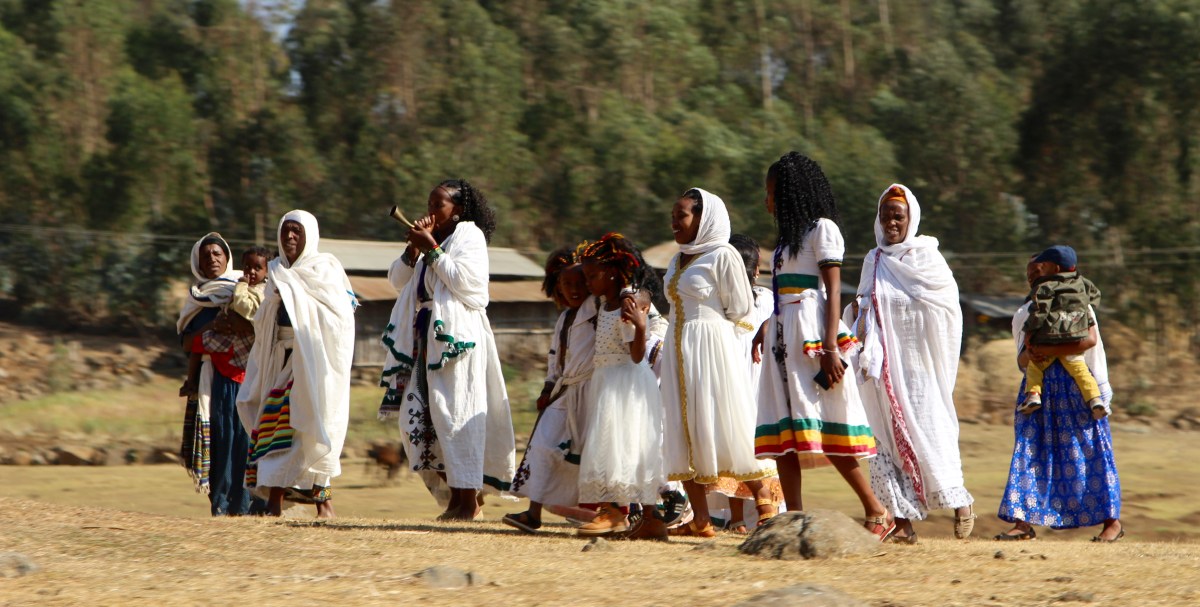
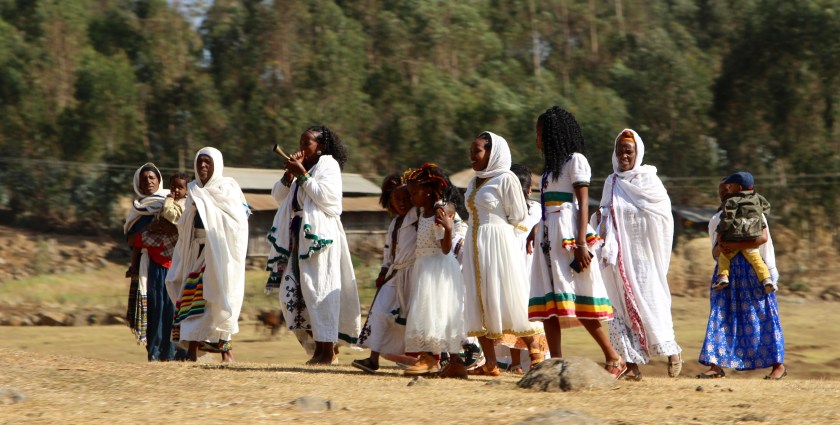
For those seeking a deeper cultural experience, the three-day Epiphany holiday of Timket does not disappoint. I did not intentionally plan my trip around it – it was more like a happy stumbling upon – but it no doubt shaped my impressions of Ethiopia and its people.
To get you in the spirit of this holiday, I offer the following musical gems. The first, of course, is Alison Krauss’ Down to the River to Pray:
And a bonus: Johnny Cash’s He Turned the Water Into Wine, performed at San Quentin:
About Timket
First, the basics: Timket, which literally means baptism, celebrates the baptism of Christ in the Jordan River. The peak day of the festival falls on January 19th each year (Tirr 11 on the Ethiopian calendar), and it just so happens that the hot spot for this celebration is Gondar, the very same jumping off point for my trek in the Simien Mountains set to start on January 20th.
You gotta love it when the stars align.
As Amin told me in Addis, watching the flurry of pilgrims packing the streets on the first day of Timket, Ethiopia is a very religious country. About 63% of the country identifies as Christian and 43% specifically as Orthodox Christian. In the Amhara region, home to Gondar and the entirety of the sites I would see in the north, well over 80% of people are Orthodox Christians.
Timket leaves you with a sense that you’re seeing Christianity in one of its oldest forms. There were moments when the rituals even felt downright Jewish. I could see why Ethiopia is such a popular travel destination for Israelis — not only is rumored to be home to the elusive Ark of the Covenant containing the original tablets Moses brought down from Mount Sinai, but it also boasts a Semetic language (Amharic), an historic Jewish community that recently emigrated to Israel, and a dry and historied earth that feels deeply Israeli. In a country where all three of the Abrahamic religions — Judaism, Christianity, and Islam — share legitimate and interesting heritages, Ethiopia illustrates how the roots of each are deeply intertwined, as well as their ability to coexist with one another when our better angels prevail.
The Magic of Gondar
I arrived in Gondar on the morning of January 19th, greeted by Melis Berihun, the brother of our trekking guide Melaku (more on them later). We immediately set off to meet the rest of the trekking group, and it did not take long for me to sense that Gondar’s Timket is an entirely different thing altogether from what I witnessed on the streets of Addis.
Let me paint you the picture: throngs of white-robed pilgrims meander the streets, darting in and out of tuk tuks (called bajaj), minibuses and other (exclusively Toyota) vehicles packed bumper to bumper. Goats, sheep and cattle scurry past the shepherds who nudge them onward, while clusters of young men with herding staffs kick up dust, dancing and chanting in circles with big smiles on their faces. Husbands and wives don matching patterns on their traditional gowns underneath umbrellas of every shade imaginable. And not infrequently, the colors of Ethiopia — red, yellow and green — adorn any and all of the above.
There is a happy and communal chaos to these streets. I will jump into the middle of this after a quick meal with my trekking companions, whom I’ll introduce in another post. Over lunch, they told me about their somewhat harrowing experience during the communal baptism that morning, and I later got to tour the bath where the major ceremony occurs.


The Camelot of Africa
The northern region of Ethiopia still reverberates with the traditions and infrastructure of the Solomonic Emperors of Ethiopia – once a ruling empire that the Amhara people identify as a point of pride. While Axum and Lalibela both served as capitols of the empire at various times, the crowning jewel is the city of Gondar with its many castles, the most famous of which is Fasil Ghebbi.
After roaming the streets, my trekking companion Inken showed me the many structures within the royal compound. I’m not really a castle person; they all start to look the same to me after a while. However, there was a dizzying amount of facilities on this spot, including libraries, saunas, churches, stables and lions cages built by different royals. So, bonus points for Gondar.


The style
I’d like to end my post with a shout out to the bold styles I saw on the streets during the celebration. The red stripes of Gondar, cowboy hats, studded suits, and more. Sigh…I love these people:


 Discover Your Yoga
One thought on “Timket”